
Cover Story
Blue Economy: Charting Bangladesh’s Maritime Renaissance in the Bay of Bengal

As the sun rises over the vast expanse of the Bay of Bengal, casting a golden hue on the churning waves, fishermen from Cox’s Bazar set out in their weathered boats, casting nets into waters that hold the promise of abundance—and peril. For generations, these coastal communities have relied on the sea for sustenance, but today, the Bay represents something far grander: a gateway to economic transformation.
As a maritime expert with decades of experience navigating the intricacies of South Asia’s coastal dynamics, I’ve witnessed how Bangladesh, once constrained by territorial disputes, now stands poised to unlock the Blue Economy’s potential. This sustainable harnessing of ocean resources could propel the nation from a lower-middle-income status toward its Vision 2041 goals, adding tens of billions to GDP while safeguarding fragile ecosystems. Yet, this journey is fraught with challenges, from climate-fueled cyclones to overexploitation, demanding bold policies and regional collaboration.
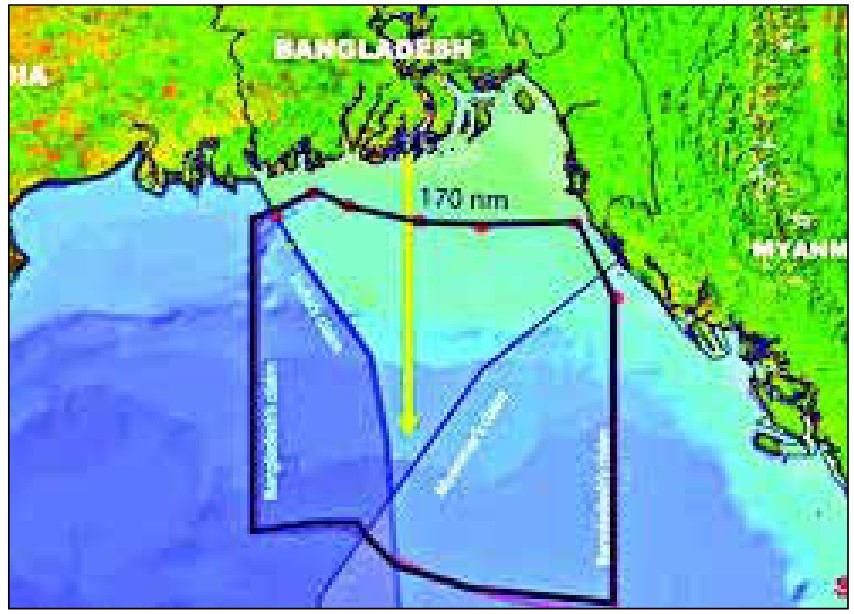
The Bay of Bengal, a semi-enclosed sea spanning 2.2 million square kilometers and shared by Bangladesh, India, Myanmar, Sri Lanka, and others, is one of the world’s most biodiverse marine regions. For Bangladesh, the resolution of maritime boundary disputes in 2012 (with Myanmar) and 2014 (with India) via international tribunals expanded its Exclusive Economic Zone (EEZ) to 118,813 square kilometers—roughly the size of Greece. This victory not only affirmed sovereign rights over living and non-living resources but also opened doors to untapped wealth beneath the waves. Marine resources already underpin livelihoods for over 30 million coastal residents, contributing to food security and poverty alleviation. Fisheries alone provide 52% of the animal protein in Bangladeshi diets, with annual marine captures reaching about 0.70 million metric tons out of an estimated 8 million tons available in the Bay. However, this is just a fraction of the potential; experts estimate that with modern techniques, output could double, injecting $2-3 billion annually into the economy.
Beyond fish, the Bay harbors gas hydrates—frozen methane deposits—potentially rivaling onshore reserves of 26 trillion cubic feet (TCF), with discoveries like Magnama holding 3.5 TCF. Seabed minerals such as zircon and rutile dot coastal belts, while renewable energies like offshore wind (with speeds up to 10 m/s) and tidal power could meet 20% of coastal energy needs by 2030, reducing reliance on imports. This aligns with global trends: the ocean economy worldwide is valued at $6 trillion, but in South Asia, it’s underdeveloped, offering Bangladesh a chance to lead through sustainable practices under SDG-14 (Life Below Water). The EEZ, part of the Bay of Bengal Large Marine Ecosystem (BOBLME), produces over 7% of global fisheries catches, yet faces threats like mangrove loss exceeding 20% since the 1980s due to aquaculture expansion and pollution.
Yet, the narrative isn’t solely one of opportunity. Recent surveys reveal an alarming 80% drop in fish stocks over seven years due to overfishing and pollution, underscoring the need for balanced growth. Plastic waste, comprising 60% of beach litter, chokes marine life, while climate change threatens a 1-meter sea-level rise by 2100, potentially eroding 10% of coastal GDP. As I reflect on my fieldwork in the Sundarbans mangroves—a natural buffer against cyclones—the urgency is clear: the Blue Economy must integrate environmental stewardship to avoid ecological collapse.
Key Sectors: Engines of Maritime Growth
Diving deeper, several sectors stand out as pillars of Bangladesh’s Blue Economy, each with unique prospects and hurdles.
Fisheries and Aquaculture: From Nets to Prosperity
Fisheries form the backbone, employing over 17 million people and contributing 3.6% to GDP, with marine fisheries alone

generating $585 million in 2019. The iconic Hilsa shad adds 1% to GDP, with successful management tripling exports to $50 million in recent years. The sector supports hundreds of thousands of jobs but faces overfishing, with 40% of surveyed stocks depleted, pollution-induced habitat degradation, and saltwater intrusion into coastal aquaculture ponds. Yet, reliance on artisanal methods limits deep-sea exploitation; only 10% of the EEZ has been surveyed. Transitioning to modern vessels and integrating aquaculture could boost output by 50-100%, yielding $1.5-3 billion in economic value, with projections reaching $8-10 billion by 2030 and 2.1 million jobs. Seaweed farming, a nascent area, holds export potential amid rising global demand, though Bangladesh trails India. Coastal aquaculture, producing 0.4 million metric tons annually, could grow 30% with sustainable practices, adding $0.8 billion. Challenges include illegal, unreported, and unregulated (IUU) fishing, which depletes stocks, and shrimp farming’s impact on salinity and mangroves. Mitigation strategies, like quotas and monitoring via research vessels such as RV Meen Sandhani, are essential. The Swatch-of-No-Ground Marine Protected Area harbors endangered species, emphasizing the need for more MPAs.

Offshore Energy: Powering the Future
The Bay’s energy prospects are transformative. Offshore gas fields hold untapped reserves comparable to India’s Krishna Godavari Basin (100 TCF), with 26 wells drilled to date across 26 offshore blocks (11 shallow, 15 deep-sea). Gas hydrates could add trillions of cubic feet, while renewable sources like wind and tidal energy suit the Bay’s strong currents and winds, potentially meeting 30% of the country’s energy demands by 2040 and reducing fossil fuel imports.
By 2030, these could power 20% of coastal grids, supporting energy security amid depleting onshore resources, with projections for 30% of coastal energy demand and 300,000 jobs. Blue energy via osmosis and biomass adds layers, but exploration lags due to technological deficits. Mineral sands reserves of 5.847 million tons, rich in copper, nickel, and cobalt, could support electronics and renewable energy storage, valued at $210 billion in deep waters.
Shipping and Ports: Hubs of Connectivity
With 90% of external trade seaborne, ports like Chittagong handle the bulk, contributing over 90% of foreign trade and $500 million from aquaculture exports. New deep-sea facilities at Payra and Matarbari could elevate Bangladesh as a transshipment hub for South Asia, with Matarbari aiming for 0.8 million TEU capacity by 2023, expanding to 2.5 million tonnes by 2041.
This could generate 500,000 jobs and handle 100 million tons yearly, retaining freight domestically. Shipbuilding, a $2 billion industry, and recycling offer further gains, but dredging and tech upgrades are critical. Maritime trade handles over 90% of exports, underscoring ports’ strategic role.
Tourism Boom: Waves of Opportunity
Cox’s Bazar, the world’s longest natural beach at 120 km, attracts 81% of international tourists, with eco-tourism on St. Martin’s Island and Kuakata’s unique views poised to generate $1 billion annually. Coastal and marine tourism contributes $6.2 billion (3% of GDP) but is underutilized; the National Tourism Master Plan (2023-2047) identifies 255 locations, focusing on low-impact resorts.
Sustainable options like marine safaris and coral conservation could boost revenue to $1.5 billion by 2030 with 500,000 jobs, while protecting biodiversity. However, infrastructure for water sports and cruises remains underdeveloped.
Economic Impact Projections
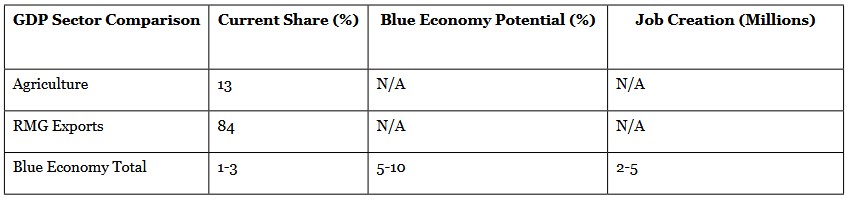
Currently, the Blue Economy contributes 1-3% to Bangladesh’s GDP ($6.2 billion in 2018), but with policy support, it could reach 5-10% by 2030, adding $20-30 billion across sectors. This dwarfs agriculture’s 13% share and complements readymade garments (84% of exports). Job creation could hit 2-5 million, lifting coastal communities. Projections estimate fisheries and aquaculture at $8-10 billion by 2030, marine renewables at 30% of coastal energy with 300,000 jobs, and tourism at $1.5 billion.
[chart: Projected GDP Contribution]
Regional Context in South Asia
In South Asia, the Bay’s littoral states boast a combined GDP of $2.7 trillion, with the regional Blue Economy potentially reaching $100 billion by 2030 through integration. Bangladesh’s central position could make it a hub, fostering maritime diplomacy for resource sharing via BIMSTEC, enabling joint patrols against IUU fishing and shared early-warning systems for cyclones, despite competition from India’s Sagarmala and Sri Lanka’s ports.
Navigating Challenges: Risks and Resilience
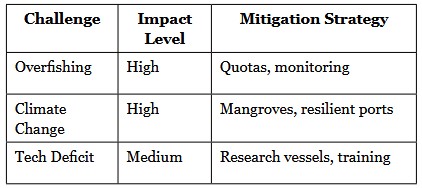
Overexploitation risks a 30% fish stock decline without quotas, while maritime pollution—1,200 tons of plastic daily—threatens fisheries and tourism. Skill gaps persist, with only 2% of the workforce trained; 100,000 mariners needed. Regulatory fragmentation across 29 ministries hampers progress. Climate change exacerbates vulnerabilities, with cyclones and sea-level rise posing empirical challenges, potentially flooding two-thirds of the country below 15 feet.
Policy Roadmap
The government’s Blue Economy Cell under the Ministry of Disaster Management and Relief coordinates efforts, with the Seventh Five-Year Plan outlining 12 actions. The Bangladesh Delta Plan 2100 emphasizes integrated water management. Investments of $5 billion needed for ports and energy by 2030, via PPPs with Japan and China. Marine Spatial Planning (MSP) could zone the EEZ for multi-use, drawing from Norway’s model where ocean economy hits $200 billion. Training via BSMRMU aims for 50,000 skilled workers. Case studies inspire: Vietnam’s aquaculture tech boosted Blue GDP by 10%; Bangladesh’s Hilsa management offers local success. An integrated roadmap aligns with SDGs, emphasizing governance, innovation, and BIMSTEC cooperation.
Future Vision: 2030 and Beyond
Looking ahead to 2030 and beyond, Bangladesh’s Blue Economy is poised to evolve into a cornerstone of national development, transforming the Bay of Bengal from an underutilized frontier into a hub of sustainable prosperity. Drawing from strategic analyses in recent reports, such as the 2025 GSC Advanced Research and Reviews article, an integrated roadmap envisions harmonizing short-term economic gains with long-term environmental stewardship. This approach aligns closely with Bangladesh’s national priorities, including the UN Sustainable Development Goals (SDGs), particularly SDG-14 on ocean conservation, and emphasizes robust governance frameworks, scientific innovation, and strategic investments to foster ecological sustainability and inclusive growth.
By 2030, key milestones could include the commencement of gas hydrate extraction around 2028, tapping into trillions of cubic feet of methane reserves to bolster energy security and reduce dependence on fossil fuel imports. Offshore wind farms, leveraging the Bay’s consistent winds of up to 10 m/s, are projected to become operational as early as 2027, contributing to renewable energy targets and powering up to 30% of coastal grids. These developments, combined with advancements in marine biotechnology and renewable energy sectors, could diversify the economy beyond traditional fisheries and shipping, positioning Bangladesh to capture a share of the global ocean economy—valued at $1.5 trillion annually today and expected to double to $3 trillion by 2030.
Regional cooperation will be pivotal, with strengthened pacts through frameworks like BIMSTEC facilitating joint initiatives on transboundary resource management, such as shared fisheries quotas and pollution control. This collaboration could secure supply chains for marine trade, mitigate climate risks like cyclones and sea-level rise, and enhance maritime diplomacy among Bay of Bengal littoral states. Domestically, these efforts integrate seamlessly with Bangladesh’s Vision 2041, the ambitious national plan to achieve upper-middle- income status by 2041 through inclusive growth and poverty reduction. Projections suggest that a fully realized Blue Economy could generate $20-30 billion in annual revenue, create 2-5 million jobs, and directly benefit over 20 million coastal dwellers by improving livelihoods, food security, and resilience to environmental challenges.
However, realizing this vision demands overcoming barriers like institutional fragmentation and limited access to finance and technology. By prioritizing water governance, marine protected areas, and cross-sectoral policies, Bangladesh can build a resilient maritime future—one where economic expansion coexists with biodiversity preservation, ensuring the Bay remains a source of abundance for generations to come. As outlined in the World Bank’s 2018 pathway report

this transition requires collaborative partnerships, from government agencies to international bodies like the EU and Duke University’s Nicholas Institute, to turn aspirational goals into tangible outcomes.