
Special Report
The Hidden Threat: Microplastics and Their Role in Exacerbating Climate Change
Microplastics (MPs)—tiny plastic particles less than 5 mm in size—represent a pervasive environmental pollutant that intersects with climate change in profound and underappreciated ways. While plastic pollution and climate disruption are often addressed separately, emerging evidence reveals their intricate connections. MPs disrupt marine carbon sequestration, foster microbial communities that emit greenhouse gases (GHGs), and contribute to ocean warming and acidification. This special report synthesizes key insights from recent research, highlighting MPs’ impacts on biogeochemical cycles, ocean health, and global sustainability efforts. It underscores the need for integrated strategies to mitigate these intertwined crises, aligning with the United Nations Sustainable Development Goals (SDGs) and human rights frameworks. At approximately 1500 words, this report calls for urgent action to curb MP pollution and safeguard planetary resilience.
Introduction: The Intersecting Crises of Plastic Pollution and Climate Change
Plastics have revolutionized modern life, from packaging and healthcare to agriculture and sanitation. However, their lifecycle—from production to disposal—imposes severe environmental costs. Annually, 4.8 to 12.7 million tonnes of mismanaged plastic waste enter ecosystems, with projections suggesting up to 270 million tonnes by 2060. MPs, derived from primary sources (e.g., microbeads in cosmetics) or secondary breakdown of larger plastics, pose unique risks due to their persistence and mobility.
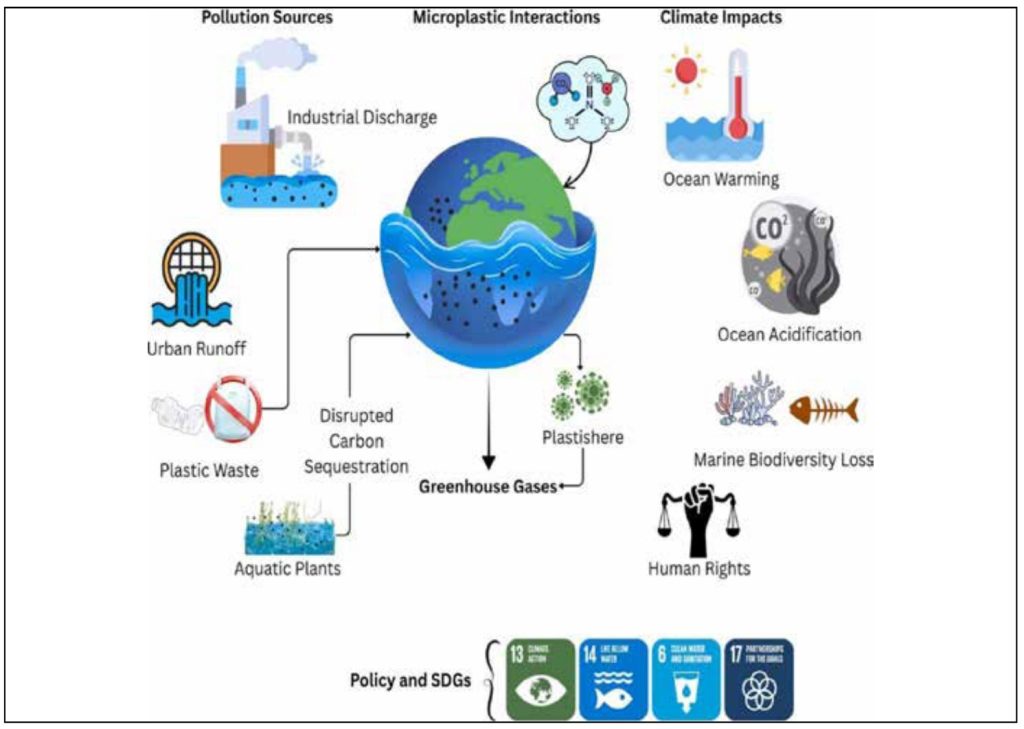
Despite growing awareness of MP pollution, its linkages to climate change remain underexplored. MPs influence oceanic carbon pumps, alter microbial dynamics in the “plastisphere,” and directly emit GHGs during degradation. In marine environments, they disrupt phytoplankton and zooplankton, key players in carbon cycling, potentially accelerating global warming. Moreover, MPs exacerbate ocean acidification by leaching dissolved organic carbon (DOC) and fostering GHG- producing biofilms. This report examines these mechanisms, drawing on ecological, social, and policy perspectives to advocate for holistic solutions. As illustrated in conceptual frameworks (e.g., sources and pathways of MPs, akin to Fig. 1 in foundational studies), addressing MPs requires viewing them not just as pollutants but as amplifiers of climate instability.
Sources and Pathways of Microplastics: A Global Menace
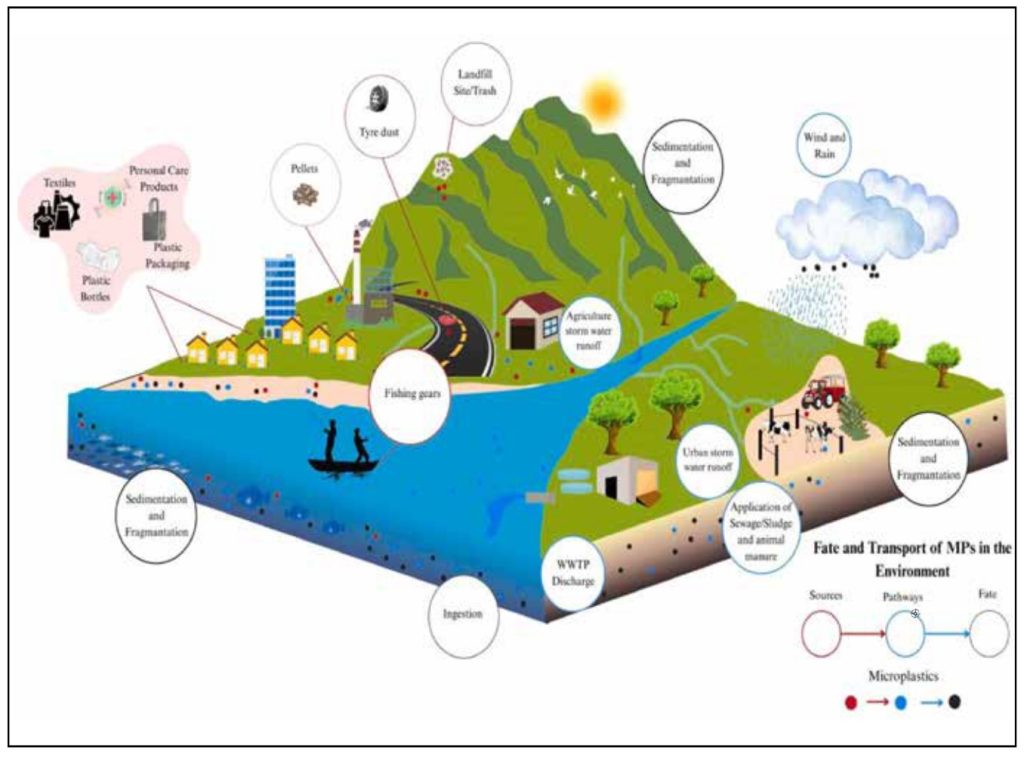
MPs originate from diverse anthropogenic activities, infiltrating ecosystems through interconnected pathways. Primary MPs are intentionally manufactured for products like personal care items, while secondary MPs result from the fragmentation of larger plastics via UV radiation, wind, and mechanical abrasion. Common sources include synthetic textiles (e.g., polyester fibers from laundry), road markings, tire wear, and single-use items like plastic bags and bottles. Industrial effluents, agricultural mulches, and wastewater from households and hospitals further contribute, with MPs often evading treatment plants and accumulating in sludge or escaping into rivers and oceans.
Geographical and environmental factors amplify MP distribution: winds, tides, cyclones, and hydrodynamic conditions transport particles across vast distances. Land-based sources account for 75-90% of oceanic plastic debris, with marine activities (e.g., fishing gear) contributing the rest. In aquatic systems, MPs form fibers, flakes, pellets, and fragments, with fibers predominant in regions like Vietnam’s rivers and beaches. Once in the environment, MPs adsorb toxins such as polychlorinated biphenyls (PCBs), heavy metals, and pesticides, enhancing their ecological threat. As depicted in interconnected source-pathway diagrams (similar to Fig. 2), MPs move from terrestrial to marine realms, underscoring the challenge of containment. This widespread infiltration sets the stage for MPs’ disruptive effects on ocean systems and climate regulation.
Impacts on Marine Ecosystems: Disrupting Carbon Cycles and Oxygen Levels
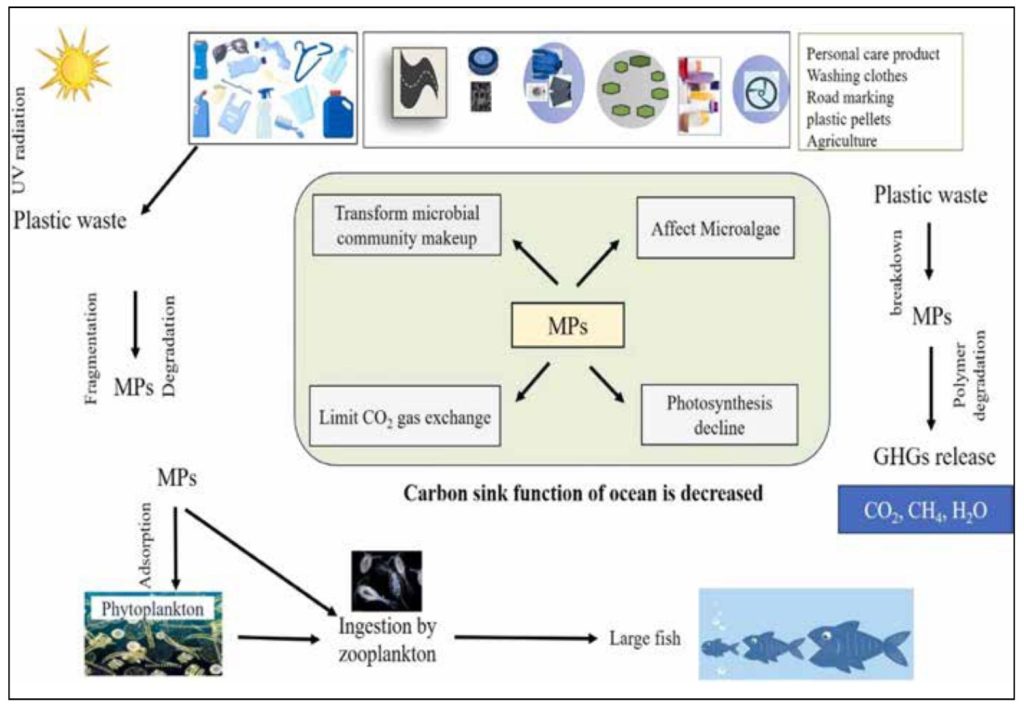
Oceans cover over 70% of Earth’s surface, acting as the planet’s largest carbon sink and oxygen producer, absorbing 25-30% of anthropogenic CO2. MPs compromise this role by interfering with the biological carbon pump—a process where phytoplankton photosynthesize CO2 into biomass, which zooplankton consume and transfer to deeper waters upon death. High MP concentrations reduce light penetration, inhibiting phytoplankton growth and photosynthetic efficiency. Studies show polystyrene MPs decrease photosynthesis in species like Phaeodactylum tricornutum, while broader contamination lowers algal biomass.
Zooplankton, vital herbivores at the food web’s base, ingest MPs mistaking them for food, leading to reduced feeding, growth, and reproduction. This diminishes grazing on phytoplankton, potentially triggering algal blooms and accelerating ocean deoxygenation. MPs also alter fecal pellet sinking rates, restricting carbon sequestration—research estimates up to 27% loss in the ocean’s carbon storage capacity due to MP-oil agglomerates. In simulated environments, MPs raise sand temperatures by 0.017°C per 1% volume, affecting temperature-sensitive species like marine turtles and inducing trophic cascades.
The plastisphere—microbial biofilms on MP surfaces—adds complexity. These communities, richer than surrounding waters, cycle nutrients like nitrogen and phosphorus but also emit GHGs (CO2, CH4, N2O) during degradation. In freshwater and estuarine sediments, MPs like PVC and polyethylene boost N2O production by shifting microbial compositions. Oceanic MPs leach DOC via photodegradation, lowering pH and enhancing acidification. Combined with atmospheric CO2 absorption, this threatens calcifying organisms (e.g., corals, shellfish) and disrupts food chains, from microbes to apex predators like sharks.
Contribution to Ocean Warming, Acidification, and Climate Feedback Loops
MPs indirectly fuel climate change by emitting GHGs throughout their lifecycle. Degradation releases CO2, methane, and ethylene, while incineration adds to atmospheric CO2. Dark-colored MPs absorb solar radiation, potentially warming surface waters and altering thermal stratification. In polar regions, MPs in snow and ice reduce albedo, accelerating melting and releasing stored particles into soils, disrupting carbon cycles.
Ocean acidification, driven by CO2 dissolution, is worsened by MPs: they lower pH, deplete calcium carbonate, and promote harmful microbial shifts. Studies link MP exposure to weakened immune responses in marine species and coral skeleton erosion. MPs also hinder blue carbon ecosystems (BCEs) like mangroves and seagrasses, which sequester carbon and buffer climate impacts. In mangroves, MPs block sunlight, entangle roots, and reduce nutrient uptake, compromising photosynthesis and resilience.
Atmospheric MPs act as cloud-condensation nuclei, influencing precipitation and radiative forcing. Agricultural plastics (12.5 million tonnes globally in 2019) alter soil properties, affecting freshwater flows and biodiversity under extreme weather. Table 1 from relevant research summarizes GHG emissions from MP degradation across ecosystems, showing promotions in N2O and CO2 in freshwater, sediments, and oceans. These feedbacks could amplify global warming, with MPs potentially altering Earth’s albedo and oceanic heat absorption.
Microplastics in the Context of UN SDGs and Human Rights
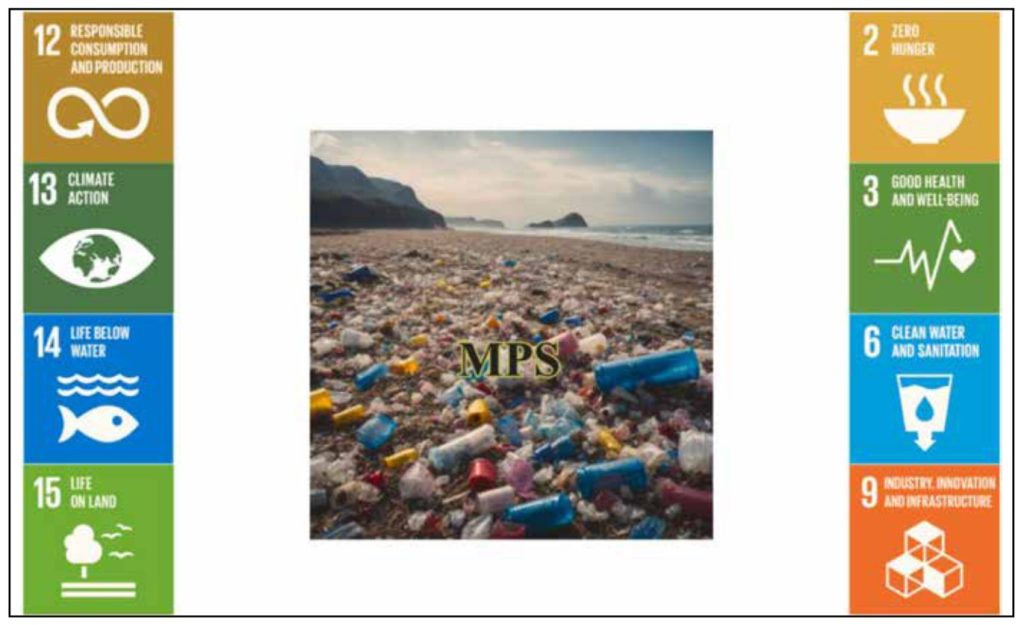
MP pollution undermines multiple SDGs, as visualized in impact frameworks (e.g., Fig. 3). SDG 2 (Zero Hunger) is threatened by soil and food chain contamination, reducing agricultural productivity. SDG 3 (Good Health) faces risks from MPs in human tissues (e.g., blood, placentas), potentially causing respiratory and endocrine issues. SDG 6 (Clean Water) is compromised by water source pollution and sewage blockages, while SDG 12 (Responsible Consumption) demands reduced plastic use and better waste management.
SDG 13 (Climate Action) is directly affected: MPs impair carbon sinks, exacerbating warming. SDGs 14 and 15 (Life Below Water and on Land) suffer from biodiversity loss in marine and terrestrial habitats. From a human rights lens, MPs violate the right to health and a clean environment, as recognized by UN agreements. The UN Special Rapporteur on toxics notes plastics’ lifecycle impacts toxify the planet, demanding rights-based policies. The ongoing Global Plastic Treaty negotiations (culminating in 2025) must adopt a full lifecycle approach to address these violations.
Research Gaps, Challenges, and Mitigation Strategies
Despite advances in MP detection and removal, gaps persist in understanding their climate linkages. Research often isolates plastic pollution from climate change, overlooking synergies. Methodological shortcomings hinder quantifying MPs’ contributions to warming and acidification, necessitating integrated studies on microbial dynamics, carbon pump disruptions, and long-term feedbacks.
Key challenges include MPs’ persistence, global transport, and amplification under warming scenarios (e.g., permafrost thaw releasing stored MPs). Mitigation requires stricter regulations banning single-use plastics, promoting biodegradables, and advancing circular economies. AI and machine learning can enhance MP tracing and removal. Public education campaigns should foster reusable practices, while international alliances (e.g., Ocean Acidification Alliance, Blue Carbon Partnership) build awareness.
Fig. 4 outlines strategies: from reducing production to improving wastewater treatment and enforcing treaties. The Paris Agreement’s oversight of ocean acidification highlights policy gaps; future frameworks must integrate MPs. Rodent and fish models can link MPs to health effects, informing evidence-based actions.

Toward Integrated Action for a Sustainable Future
MPs are not mere pollutants but active contributors to climate destabilization, disrupting carbon cycles, emitting GHGs, and eroding ocean health. Their accumulation threatens SDGs and human rights, demanding a paradigm shift from siloed to holistic approaches. By curbing plastic production, enhancing recycling, and fostering global collaboration, we can mitigate these risks. Urgent research and policy integration are essential to protect marine ecosystems and ensure planetary resilience. Failure to act risks amplifying climate feedbacks, underscoring the imperative: address MPs today to secure tomorrow’s climate.